






Thoughts can take different forms, and in our daily operations some of us experience thoughts in the form of a monologue (such as, “Whoa, what was that? Huh, what am I gonna do now? Wait, I’ve got it….”) and others experience thoughts more as images, impressions, feelings or sensations without having an “inner voice” running in the background.¹
What are Automatic Thoughts?
Whether you experience an inner monologue or not, the way we “talk” to ourselves in our thoughts impacts our self-worth.
We hear a lot of advice about watching our self-talk, because when you repeatedly say or think something, you can start to believe it, and we act based upon what we believe to be true. This may not even be a conscious process—you might be so used to thinking “I’m not smart enough to do this” or “I’m not brave enough to try that” that you automatically eliminate possibilities without taking time to consider if you really could do that thing. We call these spontaneous background thoughts and impressions “automatic thoughts,” and they shape how we plan, feel, and behave without us directly knowing it.
So then, if the automatic thoughts that pop up in the background of our mind hold such an influence over us, how can we notice this and shift the “voices” that we listen to?
Maybe you’ve heard the phrase “Don’t believe everything you hear,” and we can extend that to “Don’t believe everything you think.” Just as chatter, gossip, and rumor can hold partial information, so can our automatic thoughts.
Two-Question Thought Testing
Simply the occurrence of having a thought doesn’t mean that the information it holds is accurate or worthwhile. To find out if a thought is worth holding on to, we can use an exercise called “Two-Question Thought Testing.”
This quick exercise involves evaluating any given thought using two questions: 1) “Is this true?” and then 2) “Is this helpful?”
The answers you give to either of those questions can help you determine if that automatic thought is worth using or if you’ll discard it and choose another thought that’s more useful for you.
For example, you have some kind of test coming up (for school, in your job/for a promotion, or even a sports game) and you’re feeling pressure because this test could potentially open some doors for you. As you prepare, you have thoughts such as, “I’m going to choke, just like last time,” or “I’ll never do as well as [this person], maybe I’m not built for this.” Using the “Two-Question Thought Testing,” you’d start by saying, “Is this thought I’m having true?” If you can’t say that it’s a true or likely statement, then you redirect yourself with, “Okay, so what will I choose to focus on instead?” This helps stop a negative spiral by identifying that the automatic negative thought wasn’t very accurate, and therefore it’s not worth your time or energy.
If, however, you thought-test with “Is this thought I’m having true?” and the answer is “yes” or “It could be/I can’t tell yet,” then that leads you to the second thought-testing question of “Is this thought helpful?” If the thought is not helpful (meaning even if it is true, there’s nothing you can do to change the situation), then we redirect our mind with, “What will I choose to focus on instead?”
The process flows like this:
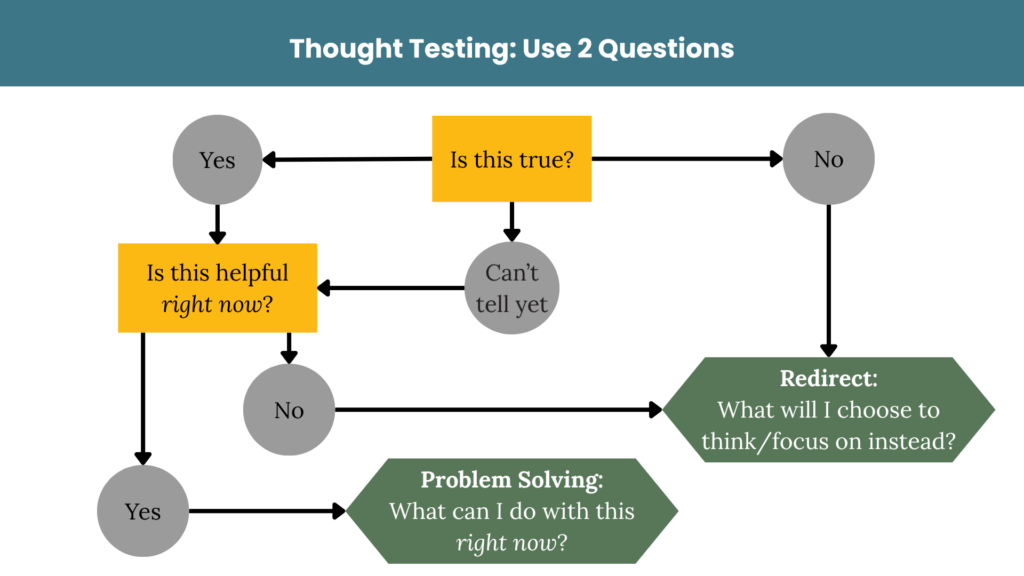
The idea is to develop a filtering process for automatic thoughts so we can catch and evaluate them for both accuracy and usefulness. And yeah, sometimes the answer is “yes” to both thought-testing questions, and in that case, we move from ruminating or a worry-spiral into proactive problem-solving mode.
Another Technique – Using “Maybe”
Another thought-evaluating exercise that takes less mental energy than the above “Two-Question” process involves treating your thoughts simply as words without assigning any meaning to them. Remember how we said, “Don’t believe everything you think”? We put that into action by picturing a thought as a stream of words that we allow to float out of our mind just as easily as it floated in, for example, as leaves blowing by in the wind or clouds drifting through the sky. As we take some slow, deep breaths and imagine the thought passing by like a cloud, we can respond with “maybe.”
- Yeah, “maybe” no one here likes me…. but maybe no one’s as fixated on my discomfort right now as I am, and maybe everyone else has their own internal concerns going on and they’re not actually judging me.
- And “maybe” I’m not built for this role that I’m trying out for, but I’ll learn something in the process, and improvement doesn’t happen if I don’t try.
If you don’t have the energy to thought test, you can still slow down and say “maybe” to deflate the weight of the thought and see if it passes out of mind as quietly as it slipped in.
I hope this perspective on your “inner voices” and these two exercises are useful for filtering your thoughts and allowing you to choose which ones will take up real estate in your mind.
If what we dwell on shapes who we become, then don’t let anything that doesn’t call you to be better get a free ride in your head.
References
- Oleś, P. K., Brinthaupt, T. M., Dier, R., & Polak, D. (2020). Types of inner dialogues and functions of self-talk: Comparisons and implications. Frontiers in Psychology, 11, 227.

Heather Ulstad, MS MERP
Heather is a business operations director and mental health professional with a background in federal law enforcement, psychology, and forensic science. She enjoys high-paced environments and has worked alongside complex teams, with a steady focus on values-driven leadership, clear communication, and collaboration. In her counseling work, Heather integrates solutions-focused, relationship-centered, and trauma-processing approaches—often starting with early experiences to help clients better understand themselves and expand resilience, confidence, agency, and potential.
Outside of work, she values time with her husband and their two daughters, loves health and performance psychology and neuroscience, and is happiest exploring the mountains, forests, and new places with her favorite people.
Learn more about Heather and our other therapists at Revelations here.