
Prioritizing for Wellness

A practical guide to managing tasks with clarity and care

There aren’t enough hours in the day for all the things I wish I could do.  But outside of eliminating the biological need for sleep, I’m not able to increase the daily time available to me.  So, the next option requires that I prioritize my to-dos to ensure I’m hitting everything I need to while not consistently overextending myself.  How do we organize our responsibilities to support our need to survive and function while also promoting our growth and wellness? 

First: Urgent vs. Important

First, it’s helpful to know what needs doing and how important it is for you.  Consider making a list of your “to-dos” and noting which are “urgent” (needs handling soon) and which are “important” (essential or of significant meaning).  See this example, which includes only personal/home responsibilities:  

Task 

Urgent? 

Important? 

Balance checkbook (avoid overdrafts) 

Yes 

Yes 

Submit insurance claim for medical visit 

Yes 

Yes 

Basement repair 

No 

Yes 

Groceries 

No 

Yes 

Holidays: make plan for family visits 

No 

Yes 

Neighborhood cookout: bring a dish 

Yes 

No 

Attend kids’ sports games this week 

No 

Yes 

Community yard sale: shop, sell 

No 

No 

Plan date w/partner 

No 

Yes 

Clean out backyard shed 

No 

No 

Your list will look different, but the goal is to identify things that need doing or that really matter to us versus things we tend to do or feel obligated to do that aren’t serving a need anymore.   

Second: Sort Your Tasks

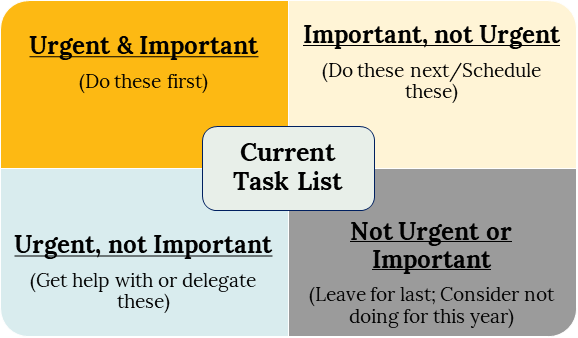
Next, take your tasks and sort them according to the quad matrix below, which serves to answer two main questions: 

  1. What can I delay?  (Doesn’t need doing right now) 
  2. What can I delegate? (Do I have to be the one executing this task?)
 

Try it Out!

This brief exercise can help us identify and prioritize the tasks we have (which brings clarity) and organize when they’ll be completed (which can bring peace, focus, and motivation to an overwhelmed mind).  There are several phone apps for this matrix as well (often called the “Eisenhower Matrix” or an “Urgent-Important Matrix”).  Give one a try—it can be helpful for listing out categories of responsibilities (work, family, home, etc.) and alleviates the mental burden of having to remember everything, all the time, while going about your day.

 

Picture of Heather Ulstad, MS MERP

Heather Ulstad, MS MERP

Heather is a business operations director and mental health professional with a background in federal law enforcement, psychology, and forensic science. She enjoys high-paced environments and has worked alongside complex teams, with a steady focus on values-driven leadership, clear communication, and collaboration. In her counseling work, Heather integrates solutions-focused, relationship-centered, and trauma-processing approaches—often starting with early experiences to help clients better understand themselves and expand resilience, confidence, agency, and potential.

Outside of work, she values time with her husband and their two daughters, loves health and performance psychology and neuroscience, and is happiest exploring the mountains, forests, and new places with her favorite people.

Share this :

Prioritizing for Wellness

There aren’t enough hours in the day for all the things I wish I could do.  But outside of eliminating the biological need for sleep, I’m not able to increase the daily time available to me.  So, the next option requires that I prioritize my to-dos to ensure I’m hitting everything I need to while not consistently overextending myself.  How do we organize our responsibilities to support our need to survive and function while also promoting our growth and wellness? 

First: Urgent vs. Important

First, it’s helpful to know what needs doing and how important it is for you.  Consider making a list of your “to-dos” and noting which are “urgent” (needs handling soon) and which are “important” (essential or of significant meaning).  See this example, which includes only personal/home responsibilities:  

Task 

Urgent? 

Important? 

Balance checkbook (avoid overdrafts) 

Yes 

Yes 

Submit insurance claim for medical visit 

Yes 

Yes 

Basement repair 

No 

Yes 

Groceries 

No 

Yes 

Holidays: make plan for family visits 

No 

Yes 

Neighborhood cookout: bring a dish 

Yes 

No 

Attend kids’ sports games this week 

No 

Yes 

Community yard sale: shop, sell 

No 

No 

Plan date w/partner 

No 

Yes 

Clean out backyard shed 

No 

No 

Your list will look different, but the goal is to identify things that need doing or that really matter to us versus things we tend to do or feel obligated to do that aren’t serving a need anymore.   

Second: Sort Your Tasks

Next, take your tasks and sort them according to the quad matrix below, which serves to answer two main questions: 

  1. What can I delay?  (Doesn’t need doing right now) 
  2. What can I delegate? (Do I have to be the one executing this task?)


Try it Out!

This brief exercise can help us identify and prioritize the tasks we have (which brings clarity) and organize when they’ll be completed (which can bring peace, focus, and motivation to an overwhelmed mind).  There are several phone apps for this matrix as well (often called the “Eisenhower Matrix” or an “Urgent-Important Matrix”).  Give one a try—it can be helpful for listing out categories of responsibilities (work, family, home, etc.) and alleviates the mental burden of having to remember everything, all the time, while going about your day.


Picture of Heather Ulstad, MS MERP

Heather Ulstad, MS MERP

Heather is a business operations director and mental health professional with a background in federal law enforcement, psychology, and forensic science. She enjoys high-paced environments and has worked alongside complex teams, with a steady focus on values-driven leadership, clear communication, and collaboration. In her counseling work, Heather integrates solutions-focused, relationship-centered, and trauma-processing approaches—often starting with early experiences to help clients better understand themselves and expand resilience, confidence, agency, and potential.

Outside of work, she values time with her husband and their two daughters, loves health and performance psychology and neuroscience, and is happiest exploring the mountains, forests, and new places with her favorite people.

Speciality/Services

Telehealth Option

Insurance Accepted